
Use this page to understand the idea, connect it to asset structuring, and continue into the next relevant ASC learning resource.
Families do not need scattered solutions. They need one coherent structure that can support growth, access, estate transfer, consolidation and compliant cross border continuity.
Why this lesson matters
By Lesson 7, you have already studied why PPLI matters in high net worth planning. Lesson 8 goes one level deeper. It explains why Tolani Flow® is not simply a policy label. It is a functional way to organise wealth inside a compliant architecture.
When a family owns assets across countries, custodians, companies, trusts and personal names, the problem is not only investment return. The problem is fragmentation. Tolani Flow® is designed to ask whether that fragmented wealth can be diagnosed, structured and continued in one coordinated framework.
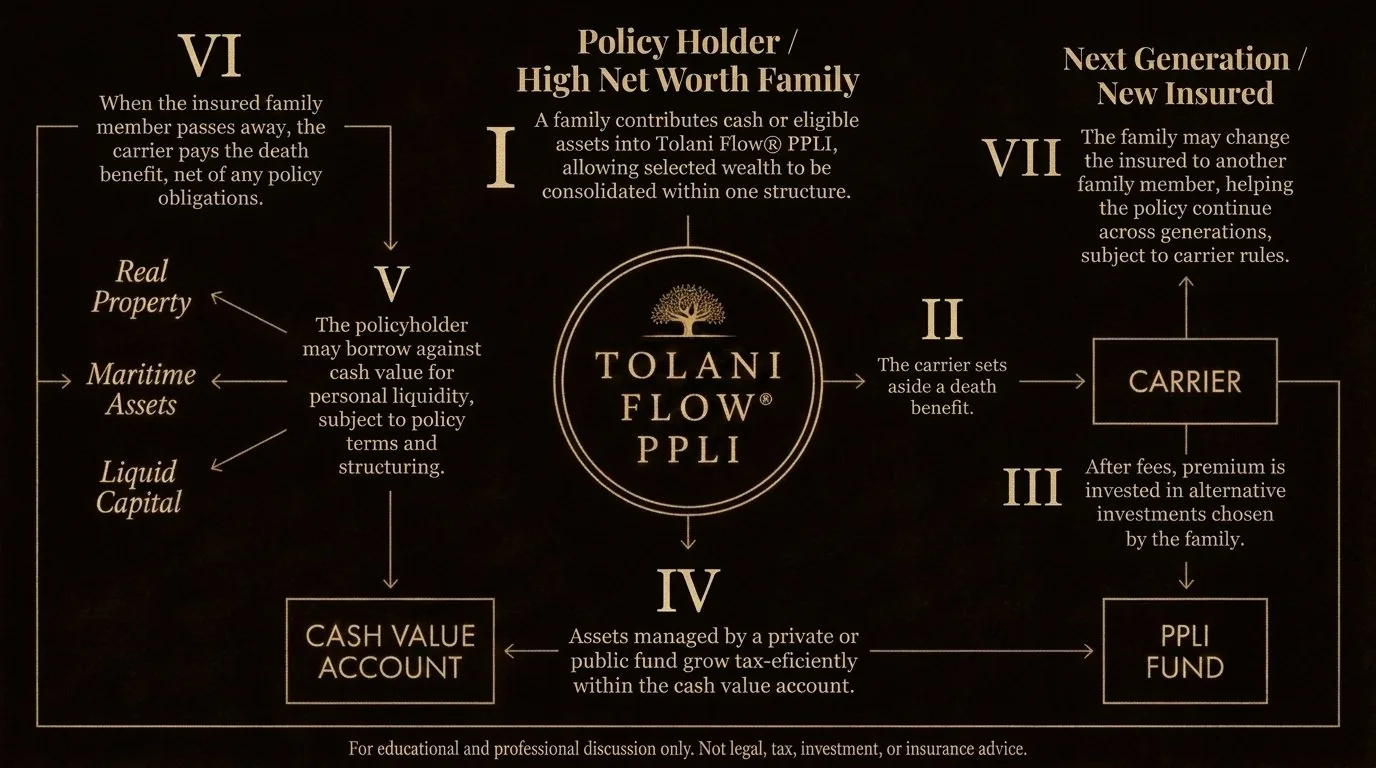
The five functions
Tax efficient growth
The first function is to reduce unnecessary interruptions to compounding. Inside a properly qualifying PPLI structure, investment income and gains may accumulate within the policy without annual taxable recognition in the same way as a direct taxable portfolio.
The advisor lesson is simple: do not explain this only as tax savings. Explain it as time. The longer capital can compound with fewer interruptions, the more powerful the structure becomes for long horizon families.
Tax efficient access
Wealth that cannot be accessed at the right moment may become trapped wealth. Tolani Flow® studies how the policy loan and liquidity features of PPLI can provide access during life, subject to policy design and jurisdictional rules.
This is the family bank idea. A family may need liquidity for business opportunities, education, investment, lifestyle or emergency events without being forced to liquidate core assets.
Estate planning outside the taxable estate
The third function is transfer. A PPLI policy can be owned through a trust or equivalent structure so the death benefit can pass according to a planned beneficiary route rather than through a slow and public estate process.
For families with businesses, real estate or concentrated assets, this can provide liquidity without forcing a sale. The policy does not replace the estate plan. It can become a liquidity and transfer layer within the estate plan.
Asset consolidation
Many families are wealthy but not organised. Assets may sit across jurisdictions, financial institutions, entities, family branches and professional teams. Tolani Flow® uses the insurance wrapper as a single structural envelope for suitable assets and a clearer management mandate.
The advisor lesson is to ask: does the family have a balance sheet, or does the family have a structure? A balance sheet lists wealth. A structure explains how wealth is owned, protected, accessed and passed on.
Cross border compliance and confidentiality
Modern families cannot build planning around secrecy. CRS, FATCA, AML, KYC and UBO rules have changed the environment. The relevant question is how to preserve legitimate confidentiality while remaining compliant.
PPLI has a different reporting profile from ordinary investment accounts. Tolani Flow® adds planning concepts such as zero cash value design and dedicated compliance monitoring to address privacy and compliance as connected functions.

The 4C lens for client language
For client conversations, the five functions can be simplified into four concerns that many high net worth families already recognise.
Confidentiality
Can the family preserve privacy without stepping outside compliance?
Consolidation
Can assets be managed under one clearer structure instead of many disconnected accounts?
Control
Can the family keep strategic control while professional managers and legal structures do their work?
Continuous flow
Can wealth continue to generate income and transfer across generations with less friction?
Why Tolani Flow® is different from standard PPLI
Standard PPLI can be useful, but the research paper identifies limitations around policy termination, CRS reporting and asset transfer friction. Tolani Flow® studies those limitations through three structural innovations.
Changing insured person
Designed to extend the policy architecture across generations instead of stopping with one life.
Convertible zero cash value
Designed to support privacy and reporting objectives while creating a clear compliance logic.
Asset exchange method
Designed to reduce tax and transaction friction when assets move inside the Tolani Flow® policy environment.
Compliance is part of the structure
A serious PPLI structure depends on compliance. In the US context, IRC 7702 determines whether the contract qualifies as life insurance for tax purposes. IRC 7702(g) explains the consequences if the contract fails to meet that definition.
That is why Tolani Flow® should be explained with professional humility. It is sophisticated, and it requires qualified advisors. The power of the framework is not that it avoids rules. The power is that it is designed to operate within a documented compliance architecture.
Advisor language
A clean way to explain the lesson is this:
Tolani Flow® is a way to study how suitable high net worth families can place wealth into a coordinated PPLI architecture so assets can grow, remain accessible, transfer more efficiently, consolidate across jurisdictions and remain compliant across generations.
Then stop. Let the client ask the next question. The moment they ask how it works, you can move into the structure dossier, the official Tolani Flow® website or a proper specialist conversation.
Questions to sit with
- Which function is the most urgent for the family: growth, access, estate transfer, consolidation or compliance?
- Which function is already handled by an existing trust, company or family office?
- Which function is missing or weak?
- Is the family trying to solve a permanent issue with a temporary structure?
- Does the family have the right professional team to evaluate suitability?
Write a one page explanation of Tolani Flow® using the five functions. Do not mention technical code sections first. Begin with the family problems: fragmentation, tax leakage, liquidity pressure, reporting complexity and succession continuity.
Continue beyond this lesson
Finish this lesson
Mark it complete, then continue to the next lesson. Your progress is saved in this browser.
Choose the next useful step.
This keeps the learner moving through the path, related answer pages and the supporting knowledge base.