
Use this page to understand the idea, connect it to asset structuring, and continue into the next relevant ASC learning resource.
Wealth should flow, not fragment.
Tolani Flow® is presented as private wealth architecture, not a stand-alone product. It sits within the broader philosophy of the Tolani Family Office: trust, vision and stewardship across generations.
The methodology was formally introduced in 2018, but its roots come from six generations of family office experience, decisions, losses, rebuilding and refinement across five continents. ASC studies Tolani Flow® because it helps explain how insurance, trusts, foundations, reporting, liquidity and succession can be viewed as one architecture.
The hidden problem: keeping wealth coherent.
As families grow across countries, asset classes, entities and generations, wealth can become fragmented. It may still appear strong on a balance sheet, but it can be exposed during succession, reporting, liquidity events, legal reviews and tax transitions.
Fragmented ownership
Assets may sit across banks, brokers, companies, real estate vehicles, trusts and personal names with no single structural map.
Tax leakage
Investment income, rebalancing, capital gains and cross border transfers can create avoidable friction when structure is absent.
Reporting complexity
CRS, FATCA, UBO disclosure, custodian reporting and multiple jurisdictions can create privacy and administration pressure.
Succession fragility
Without a dynasty level architecture, wealth can be forced into probate, family disputes, liquidity stress or unintended transfers.
Liquidity mismatch
Families may be asset rich but structurally illiquid during inheritance, tax, business or family transition moments.
Governance gaps
Trusts, foundations, policies and companies may exist, yet not work together as one coherent family wealth system.
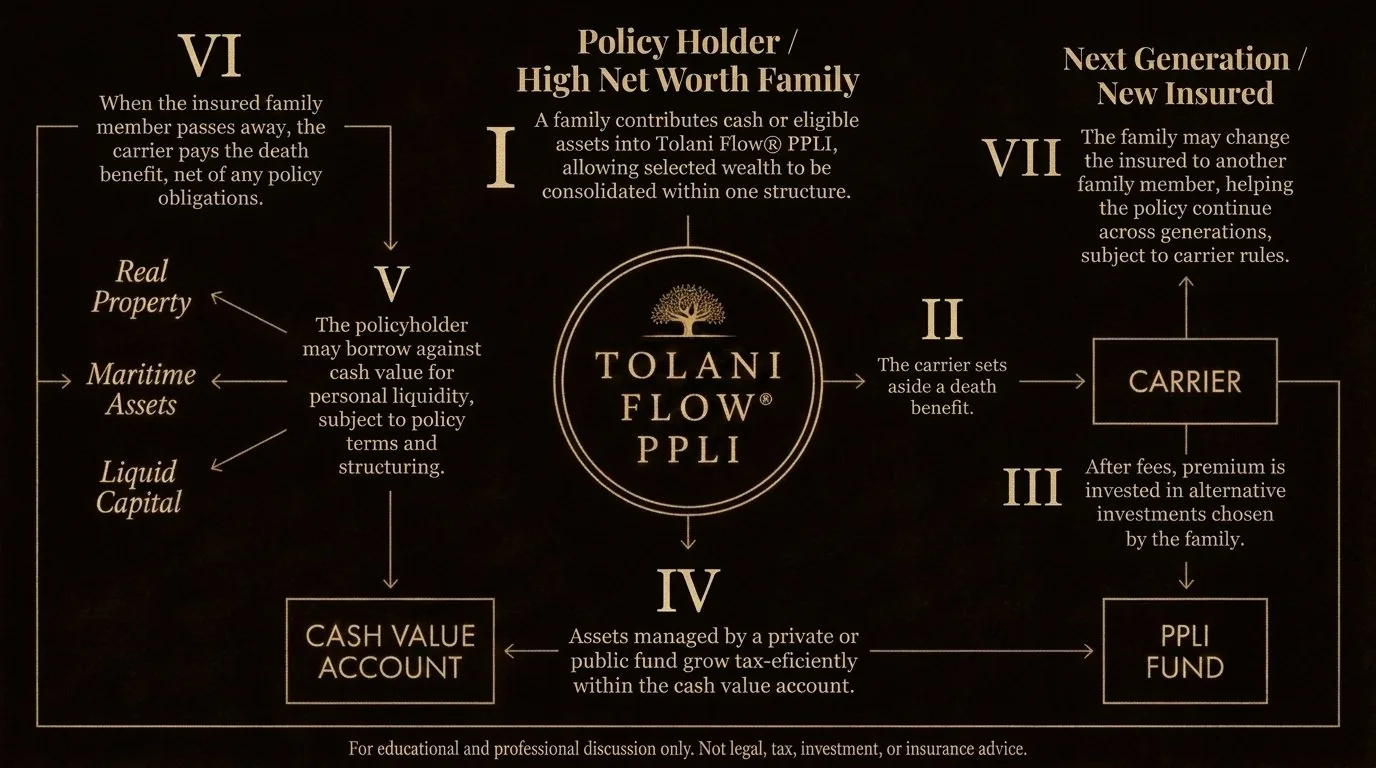
The three-stage Tolani Flow® view.
The framework can be understood in three stages: diagnose unstructured wealth, structure qualifying assets through a compliant PPLI architecture, then continue the family wealth system across generations.
ownership, tax, reporting, liquidity and succession risks
trust or foundation owns the PPLI policy
protection, growth, legacy, impact and continuity
How the structure is commonly explained
The family establishes a governance vehicle. The governance vehicle may own the PPLI policy. The PPLI can consolidate qualifying assets within a tax efficient, succession aware wrapper, subject to jurisdiction, carrier rules, policy terms and professional review.
- The family may involve principals, settlors, insured persons and beneficiaries.
- A trust or foundation may act as the governance and ownership vehicle.
- The PPLI wrapper may hold qualifying assets under the policy architecture.
- The design may support liquidity access, death benefit planning and continuity for the next generation.

Five pillars of flow.
When wealth is properly architected, it is no longer merely owned. It is protected, governed, compounded, transferred and continued by design.
Protection
A defensive perimeter reduces asset level exposure across legal, tax and jurisdictional risk.
Growth
Tax efficient architecture allows capital to compound with fewer unnecessary interruptions.
Legacy
Governance frameworks align assets, heirs, values and family decision making.
Impact
Philanthropic capital can become part of the family structure, not a late-stage afterthought.
Continuity
The structure is designed to outlive the founder and continue across generations.
Three structural innovations studied by ASC.
Standard PPLI can be powerful. Tolani Flow® is studied as an evolved framework for families seeking continuity, privacy and coherent asset transfer design.
Unbroken continuity
A changing insured person mechanism may help extend the policy architecture across generations, reducing the typical lifecycle limitation of standard insurance planning.
The stealth perimeter
The convertible zero cash value approach is presented as a privacy architecture that enhances confidentiality while preserving compliance discipline.
Frictionless asset exchange
The Tolani Flow® Asset Exchange Method supports internal asset movement within the policy environment, reducing unnecessary transaction friction when properly structured.
A protective wrapper, not a replacement.
Tolani Flow® is not presented as a replacement for the family office, trustee, lawyer, banker or existing holding structure. The objective is to create a coordinated layer around them so the family's financial life becomes more private, more liquid and more continuous.
- Works alongside trusts, foundations, family offices and holding structures.
- Provides a consolidated architecture for qualifying global assets.
- Creates a succession aware framework for heirs and beneficiaries.
- Positions insurance as a strategic asset class within family wealth design.
Who should study this structure?
Tolani Flow® is most relevant when a family's jurisdictions, heirs, assets and planning objectives have outgrown conventional product based planning.
Global families
Multi-asset, multi-jurisdictional families seeking long term continuity, privacy and a clearer family wealth map.
Family offices
Single or multi-family offices seeking a structured layer around existing governance, reporting and succession arrangements.
Entrepreneurs
Business owners preparing for succession, liquidity events, heir equalisation or ownership transition across generations.
Advisory teams
Trustees, lawyers, private bankers and wealth advisors serving complex family clients who need coordinated planning language.
Continue learning.
To study Tolani Flow® further, visit the dedicated Tolani Flow® website or continue through the ASC learning path.
This page is general education only. It is not legal, tax, investment or insurance advice. Families and advisors should consult qualified professionals in the relevant jurisdictions before implementing any structure.