Use this page to understand the idea, connect it to asset structuring, and continue into the next relevant ASC learning resource.
Why US tax awareness matters
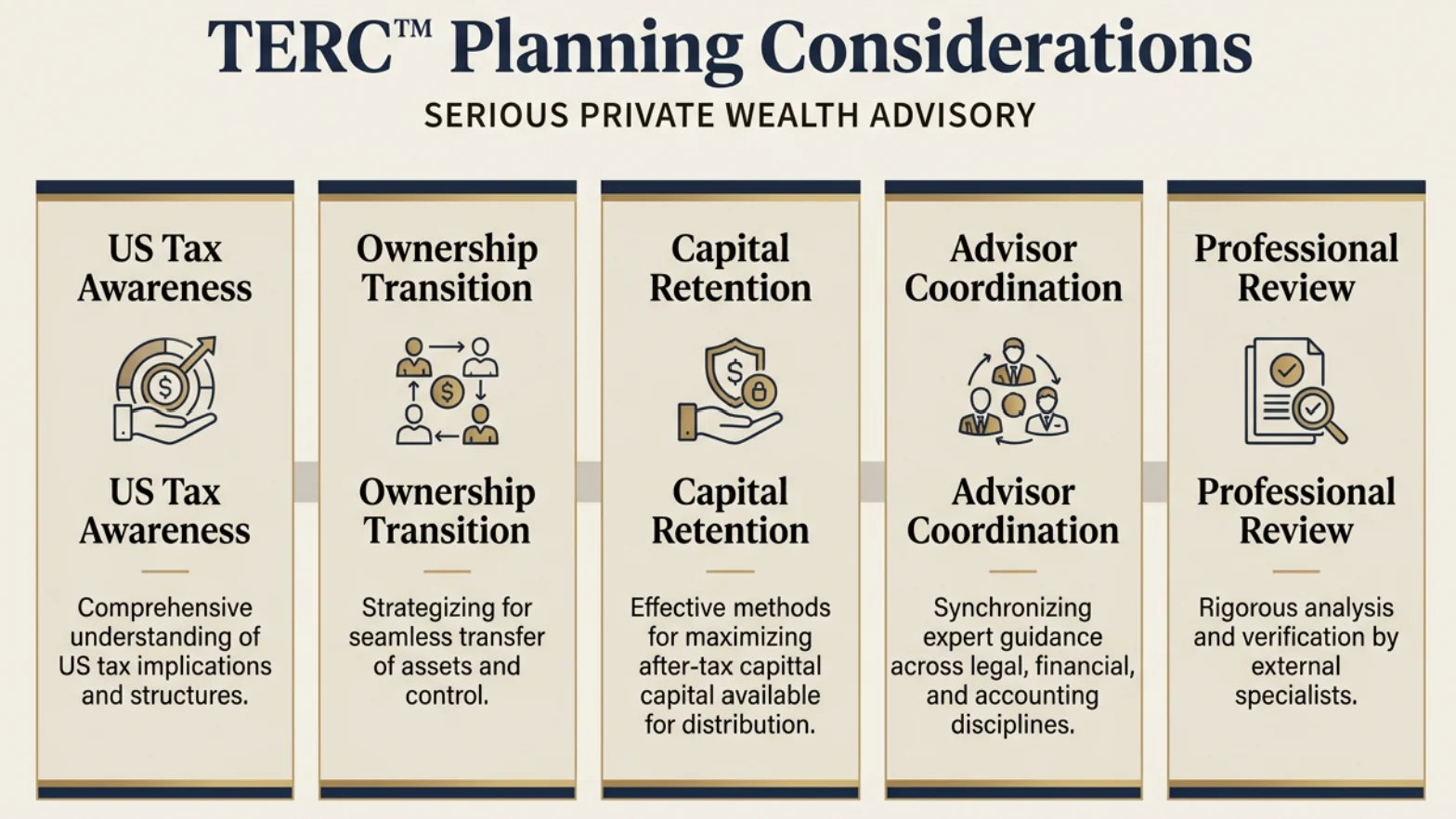
Families who own, sell, inherit or invest in US connected assets often underestimate how many tax systems can affect the same pool of wealth. FATCA reporting, income tax, capital gains tax, estate tax, gift tax and state level inheritance rules can all appear in the planning conversation.
The retained capital idea
Retained capital means capital that remains available for productive use after a transaction, sale, succession event or tax event. A structure that allows more capital to remain working may support business continuity, succession funding, reinvestment, philanthropy, estate liquidity and family planning.
Architecture studied inside TERC™
US tax map
The planning starts with the exposure: US income, US situs assets, US persons, business ownership, gift tax or estate tax.
Ownership and transition
TERC™ studies ownership design and succession planning, including where ESOP style thinking may support continuity.
Risk and insurance architecture
Captive insurance and related risk structures may appear for families or businesses with enough scale and compliance infrastructure.
Retained capital outcome
The desired result is not a tax trick. It is a structure where more capital remains legally available for the family’s chosen purpose.
Who should study TERC™
- Business owners preparing for sale, succession or ownership transition.
- Families with US connected assets who want to understand possible tax exposure before a transaction.
- Owners exploring employee ownership, succession, retention or liquidity planning.
- Families with enough scale to consider advanced insurance or captive risk architecture.
- Advisors who need to recognise when a US tax specialist should enter the conversation.
Questions before any TERC™ conversation
- What US assets, US income or US persons are involved?
- Is the family facing income tax, capital gains tax, estate tax, gift tax or state inheritance tax?
- Is the event a sale, succession transfer, liquidity need, ownership restructure or risk management issue?
- Does the business have enough scale and risk profile to support captive insurance architecture?
- Which tax attorney, insurance specialist and corporate advisor must be involved before implementation?
Return to the Structures Library.
Compare TERC™ with Tolani Flow® PPLI, Dynamic Trust™ and IFA as part of the wider ASC structure map.
Educational material only. TERC™ implementation requires qualified US tax, legal, corporate and insurance professionals.